Bébert’s Aunt
Journey to the End of the NightBébert’s Aunt is Bébert’s guardian and the concierge of the building where Ferdinand Bardamu practices medicine. She brings Bardamu into the family’s daily life, at first seeking advice for ordinary concerns and later relying on him through Bébert’s prolonged, fatal illness. Her portrayal links neighborhood poverty and mistrust of medical care with the intimate, unequal obligations of a doctor who often treats patients for nothing.
Identity and Place in the Neighborhood
Bébert’s Aunt works as a concierge and is often away on errands, leaving Bébert to mind the lodge. Bardamu first encounters him sweeping the sidewalk while his aunt is out shopping. The aunt has also worked for a doctor and presents herself as knowledgeable about hygiene; she offers consultations to neighbors, sometimes as far away as Bezons. Her own medical advice and Bardamu’s professional role overlap uneasily: she turns to him for a free consultation, but she also makes herself an intermediary through whom neighborhood gossip and family anxieties reach him.
The building’s residents watch Bardamu and Bébert talk in the street. In this close-knit setting, private troubles do not remain private for long. The aunt worries about what neighbors might think, while stories about Bardamu’s conduct spread through the district and later affect how other doctors and residents regard him. Her life as a concierge places her at the center of this circulation of news, even as she is herself exposed to its judgments.
Her Dependence on Bardamu
The aunt asks Bardamu to prescribe a syrup intended to stop Bébert from touching himself, repeating an accusation she has heard from the Gagat family upstairs. Bardamu follows her into the lodge and writes the prescription. He later recognizes that he has been too accommodating: he treats the poor residents without charge, accepts their accounts without much resistance, and finds himself increasingly subject to their demands. In his account, the favors do not create a simple bond of gratitude. They leave him vulnerable to being imposed upon, while the patients’ confidence exposes him to the private distress they share with him.
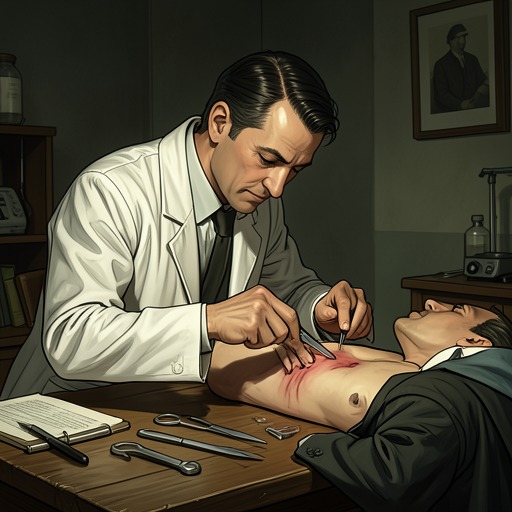
That dependence becomes more serious when Bébert falls ill. The boy grows steadily thinner, loses the desire to move, and remains lucid for a time despite a temperature that rises from 102 to 103 degrees. Bardamu visits him over more than a month and tries baths, serum, a dry diet, and vaccines, but the illness resists his efforts. Other residents advise the aunt to dismiss Bardamu and seek a more imposing doctor. The episode involving the Gagat girl has already circulated through the neighborhood and damaged his standing. Yet other doctors, once told the nature of Bébert’s illness, are unwilling to take the case, so Bardamu remains responsible for treating him.
Grief and the Search for an Explanation
As Bébert’s condition worsens, the aunt’s usual talk falls away. She becomes quiet and breaks down in different corners of the lodge, trying to wipe away her tears before grief returns. Her repeated exclamation, “Oh dear!”, marks the limit of what she can say. The grief comes and goes for weeks; she grows exhausted and bewildered, but cannot make the loss comprehensible by speaking about it.
Even while Bébert is gravely ill, the aunt searches for a cause that might make his sickness intelligible. She wonders whether rum and chamomile tea he drank at a fruit shop on the day of a bicycle race could have made him ill. Bébert faintly echoes the word “Camomile!” from his fever. Bardamu does not try to correct her. He continues the professional gestures she expects, then leaves to face the night with his own sense of guilt: he cannot feel entirely innocent of terrible events, even when his efforts have failed.
Character and Narrative Significance
The aunt’s conduct shifts with Bébert’s illness. Earlier, she talks incessantly, seeks remedies, and uses Bardamu’s generosity for the household’s needs. As the boy declines, her explanations cannot change the course of the disease, and words that once seemed abundant become a small, repeated cry of distress. The contrast makes grief visible not as a composed response but as something that interrupts and overwhelms her ordinary habits.
Through the aunt, the novel shows the costs of care in a poor neighborhood. Bardamu charges little and often nothing, yet his patients’ trust does not free him from pressure, gossip, or responsibility. The aunt is neither simply an antagonist nor merely a grieving relative: she relies on a doctor whose resources are limited, while his account of her dependence is filtered through his frustration at being used and his fear of failing Bébert. Her grief, and Bardamu’s inability to relieve it, expose the distance between performing medical care and being able to save a patient.